Closing the Gap Between Data Extraction and Downstream Usability
Healthcare claims intake often begins with documents and supporting information that must be converted into usable digital data.
But digitization does not eliminate the harder problem.
A payer can capture an incoming document successfully and still leave downstream teams with questions about what it means, which claim it belongs to, whether the information is complete, how reliable the extracted data is, and what should happen next.
Consider a supporting document submitted for a claim. The system may successfully extract the provider identifier, service date, and billed amount. But if it cannot establish which claim the document supports, identify conflicting information, or flag missing details, an employee may still need to investigate before processing can continue.
That is the next challenge in healthcare claims intake automation.
The operating question is no longer only whether information can be captured from a document. It is whether that information reaches downstream claims operations with enough context, consistency, and confidence to support the next step reliably.
For payer leaders, that distinction matters because intake quality directly affects how much interpretation, exception handling, and corrective work the rest of the claims operation must absorb.
Claims Intake Needs an Information Layer, Not Just a Capture Layer
Incoming claims-related documents can vary widely by source, format, structure, terminology, and completeness.
A capture layer can convert that information into digital content.
But downstream operations still need to understand how the information fits into the claims environment.
That may require connecting a document to the correct claim, identifying relationships between fields, determining whether values conflict with existing information, and deciding whether the document is complete enough to support further processing.
This is where the role of intake begins to change.
The higher-value function is not simply reproducing a document digitally. It is translating incoming content into a consistent operational representation that downstream systems and teams can use.
For payer leaders, that creates a different standard for claims intake.
The question becomes less about how much information was captured and more about whether intake created a sufficiently reliable information layer for the operation that follows.
Context Matters as Much as Extraction
An extracted field can be technically accurate and still be operationally misunderstood.
A number on a document may represent a billed amount, paid amount, adjustment, service-line value, or reference to another transaction.
The characters may have been captured correctly.
The business meaning may still be unclear.
That creates an important distinction for healthcare claims data capture:
Data accuracy and contextual accuracy are not the same thing.
The same issue applies to dates, identifiers, status fields, provider information, and supporting documentation.
If those values are separated from the relationships that give them meaning, the resulting data may be accurate at the field level but still insufficient for the downstream process.
Intelligent intake therefore needs to preserve enough context for downstream operations to understand what the information means and how it should be used.
For executive leadership, that is an information-governance issue as much as a document-processing issue. Reliable downstream decisions depend on preserving the business meaning of the information entering the workflow.
Normalization Matters More Than Document Format
Healthcare documents often express similar information in different ways.
One provider may use one label for a field, another may use different terminology, and a third may present the same information in a different structure.
Those variations are common across document sources.
For claims operations, however, they create unnecessary complexity.
The downstream process benefits when incoming information can be normalized into a consistent representation.
That may mean aligning similar values to common fields, applying consistent categories, standardizing terminology where appropriate, or mapping information into a structure that downstream applications can interpret reliably.
For example, the same type of service information may appear under different headings or in different sections of supporting documents. Normalization helps map these variations to consistent data fields so downstream systems and teams can interpret the information more consistently.
This is where document intelligence in healthcare can create more value than extraction alone.
The objective is not to force every document into the same template.
It is to reduce avoidable variation before that variation becomes a downstream processing issue.
At scale, that matters because every unresolved variation increases the amount of interpretation the claims operation must perform later.
Intelligent Intake Should Make Uncertainty Visible
Automation often gets evaluated by how much work it can complete without intervention.
That can create the wrong incentive.
A mature intake process should not only produce an output. It should also identify when that output may not be reliable enough for automated use.
Uncertainty can come from incomplete documentation, poor image quality, conflicting values, mismatched identifiers, unusual document structures, or low-confidence extraction.
Uncertainty itself is not the management problem.
The more important issue is whether the intake process makes that uncertainty visible before downstream operations rely on the information.
That changes the role of intelligent claims capture.
The objective is not to hide ambiguity behind a completed workflow status. It is to surface ambiguity early enough for the organization to respond appropriately through validation, targeted review, or a different workflow path.
For payer leaders, the control principle is clear:
A reliable intake process should distinguish between information it can process with confidence and information that still requires interpretation.
That creates better control because operational uncertainty remains visible instead of being transferred silently downstream.
Document Intelligence Can Move Exception Detection Upstream
Some claims exceptions become visible only after work reaches downstream processing.
A rule may fail. An expected document may be missing. A value may conflict with another system. Supporting information may not align with the claim.
At that point, the organization has already invested effort in discovering the problem.
Document intelligence creates an opportunity to identify some of those conditions earlier.
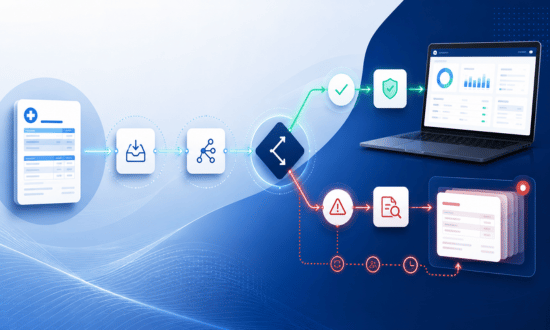
It may help surface document-to-claim mismatches, missing expected information, conflicting identifiers, duplicate or potentially duplicate submissions, or other forms of intake ambiguity before they become downstream processing problems.
Identifying a potential exception does not always mean the system can resolve it automatically. For example, a potential duplicate submission may need to be checked against claim details and other available records before it can be confirmed. The value of early detection is that the issue becomes visible sooner, allowing the appropriate team to investigate before more processing work takes place.
That does not mean every claims exception originates at intake.
It means some intake-related exceptions can be identified earlier when incoming information is evaluated with more context.
For leadership, the advantage is not simply faster detection. Earlier visibility can reduce avoidable downstream handling and help preserve operating capacity for work that genuinely requires claims expertise.
Digital Mailroom Management Should Be Judged by Information Quality
Digital mailroom management solutions often get evaluated through document volume, processing speed, and digitization turnaround.
Those metrics are useful, but they do not fully show whether the mailroom improved the operation that follows.
Once documents are received and digitized reliably, the more important question becomes:
What quality of information is entering downstream workflows, and how much additional work does that information create?
A stronger operating model considers whether incoming information is correctly associated, sufficiently normalized, appropriately validated, and accompanied by clear signals when uncertainty remains.
Document throughput measures movement.
Information quality measures whether intake is producing more usable inputs for the rest of the organization.
A mailroom that processes documents quickly but still requires substantial downstream reclassification or correction has improved one part of the workflow without necessarily improving the economics or control of the full process.
This is why claims intake performance should be evaluated beyond document volume and extraction rates. Leaders should also examine observable downstream outcomes, such as:
- Downstream reclassification and reassignment: How often incoming information needs to be interpreted or routed again.
- Validation failures and correction activity: How frequently records require additional checks or corrections after intake.
- Intake-related exceptions: How often missing information, conflicting values, or document mismatches interrupt processing.
- Manual handling effort: How much additional employee time is required to resolve issues that could have been identified earlier.
Comparing these measures against baseline performance can help health plans understand whether improvements in intake are reducing downstream effort rather than simply shifting work to another team.
No single metric will apply to every payer.
But the principle is consistent:
The quality of intake is ultimately visible in the work it prevents downstream teams from having to repeat or correct.
That shifts the business case from document throughput toward operating leverage.
If intake improves the quality of information before it enters the claims process, the organization can reduce avoidable downstream effort without requiring equivalent growth in administrative capacity.
AI in Healthcare Claims Administration Depends on the Quality of the Information Layer
When AI is used in healthcare claims administration, information quality becomes even more important.
AI-enabled workflows may classify work, identify patterns, prioritize review, or support operational decisions.
Those capabilities still depend on the information entering the workflow.
If intake produces data that is incomplete, inconsistently normalized, poorly associated, or insufficiently contextualized, downstream automation inherits those weaknesses.
AI downstream cannot reliably compensate for information that entered the workflow without enough context, consistency, or confidence.
A stronger information layer at intake can give downstream workflows more consistent and usable inputs.
This does not make document intelligence the same as claims adjudication.
It means intake quality becomes part of the governance foundation for downstream automation.
For payer leaders, that makes claims intake an enterprise information-quality issue, not simply a document-processing function.
The Future of Claims Intake Is Operationally Ready Information
The evolution of claims intake should not be understood simply as OCR being replaced by AI.
OCR remains foundational to OCR claims processing.
The larger shift is from recognizing content to preparing information for operational use.
That progression looks more like:
document → text → structured information → contextualized information → operationally ready work
Document intelligence extends the value of OCR by helping preserve context, normalize information, expose uncertainty, and connect incoming content to downstream business processes.
That changes where intake should be considered complete.
The boundary should not end when a document has been scanned or a field has been extracted.
It should end when the next operation can use the information with substantially less need to reconstruct context that intake could have resolved earlier.
The next stage of healthcare claims intake will depend on more than how many documents payers can digitize.
It will depend on how reliably intake converts diverse incoming information into consistent, contextualized, and trustworthy inputs for downstream claims operations.
For executive leadership, that is ultimately a question of operating leverage and control.
The real measure of document intelligence is the amount of interpretation, correction, and avoidable administrative effort the rest of the claims operation no longer has to perform.
At MDI NetworX, this reflects a broader focus on improving how healthcare information moves through payer operations. Through our document management and claims capture and processing solutions, we support the processes that help turn incoming information into usable inputs for downstream work. The objective is to improve the quality and flow of information while helping reduce avoidable manual effort across the operation.
FAQs
What changes when healthcare claims intake moves beyond OCR?
OCR converts document content into machine-readable text. Document intelligence extends that capability by helping preserve context, normalize information, identify uncertainty, and connect incoming content to downstream workflows. The objective is not simply better text recognition, but more operationally usable information.
Why can accurately extracted data still create downstream claims problems?
A value can be extracted correctly while still lacking the context required to use it appropriately. If the organization cannot determine what the value represents, which claim it belongs to, or how it relates to other information, downstream teams may still need to interpret or correct it manually.
How does document intelligence help identify uncertainty earlier in claims intake?
Document intelligence can help surface conditions such as incomplete information, conflicting values, low-confidence extraction, unusual document structures, or mismatches between a document and the expected work item. Making those conditions visible earlier can support targeted validation before the information reaches downstream processing.
Why does normalization matter in healthcare document processing?
Different documents may express similar information in different formats or terminology. Normalization reduces that variation by translating information into a more consistent structure, making it easier for downstream systems and teams to interpret and use.
How should payer leaders measure the operational value of claims intake automation?
Leaders should look beyond document volume and extraction rates. Useful measures may include downstream correction, reassignment, validation failures, intake-related exceptions, and the amount of manual interpretation required after intake. The goal is to understand whether automation reduces administrative effort and improves the quality of inputs across the broader claims operation.
Subscribe To MDI Focus
Signup for free and be the first to get notified on new updates.
Tags
Stay Connected